When Teen Mothers and Their Babies Live With Grandparents
Some Questions About My Mother
Tin I make sense of her death by assuring myself of her life?
The author and her mother in 1984. Photo: Kate Ristow
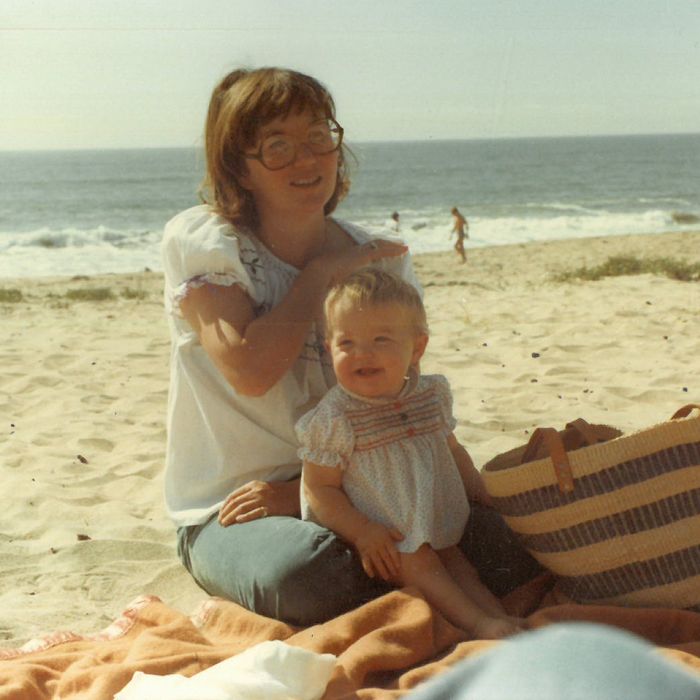
The author and her mother in 1984. Photograph: Kate Ristow
The writer and her female parent in 1984. Photo: Kate Ristow
During the last few years of her life, my mother didn't bother with the wig she wore when I was small. Her peel was gray, and she was so thin that her ribbed cotton leggings were loose around her thighs. She wore patterned head scarves and thick sweaters and a collection of medals tangled around her neck. They were saints, mostly, but she wore other relics, too: a moonstone, a small tarnished bell. She developed an interest in professional baseball. She stayed funny and kind. She suffered from both honesty and deprival. She ever had a lot of respect for immature people. She never told me it was all going to be okay. I wonder what she would tell me now.
As a child, I was attached to her in the physical, obsessive way that a lot of kids are to their mothers, simply also peradventure more and so because I always understood she was dying. She had cancer for 12 years; she went into remission just the cancer came back, which meant I was always waiting for information technology. In fact, I've never been able to break the habit, even though she is gone.
When I was 6 or 7, we went to the animal shelter, where I chose a kitten that had long black fur and foggy eyes and was so sick that the staff told us she wouldn't alive longer than a couple of days. Information technology's easy to presume this was a lesson in mortality, but maybe that wasn't it at all. Maybe she just couldn't say no. Either fashion, she permit me take the kitten dwelling house, where I fed her with an eyedropper and held her in the crook of my arm until she died. I should say I was distressing, I think, though that'southward not how I remember information technology. The kitten'south death had e'er been function of the plan. I buried her under the lilac tree with all of my other dead pets — a rabbit, another cat, a guinea grunter, innumerable goldfish.
I was xv when my mother died. The physical reminders of life were the cruelest at starting time: sweaters and sneakers and scarves, teapots, books, a stick of chroma, the but makeup I always saw her vesture. Later, it was the people, her friends, who loved her so much, her sisters, the kids she worked with in the school intervention program. I was never immune to know who they were, though I often did. We lived on an isle. Our school was pocket-size. Anyway, I would have known by the way they looked at her. I found an former note from ane of them while going through old photos recently. "Dear Cecily," it says. "I'm sorry you died."
The writer's mother when she was near 30. Photo: Kate Ristow
For a long time, I thought I might solve the puzzle of my mother's death by assuring myself of her life. I wanted stories and proof. I typed her name into search engines, though in that location was never anything there. When she died, people spoke about her bravery in the style they ofttimes do of the dead. And she was brave. She chose treatments that were aggressive and experimental. She did Reiki and acupuncture and filed for defalcation. She visited something called a "Theosophical Center" and sought spiritual guidance while I ate a bowl of chocolate-brown rice and stared boredly at the sea.
In other words, she tried to live. People said she did it for me and my brother, her children, but that is merely function of the story. She wanted to alive because she was expert at it. She would take continued to exist adept at information technology.
When my children were born, the need to understand my female parent's life, and what information technology could accept been, heightened. Information technology was equally if she alone could solve the mystery of early motherhood'south unmoored days. I wondered where she would be, for instance, if I were to call her in the middle of the afternoon. Where would she exist standing? What would she exist property? Toward the end of her life, she started painting. Would she still? What would she be reading? Where would she have been (in a day, in a year)? What would she want? Would she tell me the story of my nascence? Would in that location even so be half-full glasses of iced tea, left similar a map of her path, around the house?
I am aware that imagination is express hither, driven only by a simple fact: She was my mother; I wish I could know her.
"I desire you lot," my 4-year-onetime daughter sometimes says, usually when I am tired and singing her to sleep. She puts my mitt on her confront and breathes in, eyes closed, rima oris open and then I can feel her hot breath on my palm. "I'm right here," I tell her, my vocalism impatient, even though I know exactly what she means.
The last time I saw my mother, she couldn't speak but she watched me, unblinking. I stood in a corner up against a wall. I didn't lie beside her. I didn't hold her hand or say proficient-goodbye. Nobody told me to exercise those things, and when I remember about that now, I recognize their kindness.
My female parent died the next day. Information technology was March, and for a long time, the ending of winter was marked by the brackish dread of waiting. I knew she was expressionless right earlier the telephone rang. I remember that sometimes when I wake up in the nighttime, moments before my children cry out for me. And then much of life is repetitive. One long, fragile cord.
I don't call up the date my mother died anymore. On Mother's Mean solar day, my kids paint me pictures, and I accept a long run alone. I attempt to tell my children what I know about their grandmother — well-nigh her Volkswagen Beetle convertible with the pigsty in the lesser, the pranks she used to play on united states, how she learned to tap dance as an adult, how mad I was that the cats preferred to sleep on her bed instead of mine.
"Why?" my daughter asks.
I tell her how quiet my female parent was, how she knew how to stay still and wait. There's more than to her than all that, of course. Only it's not for words. It's an instinct, ingrained but barely detectable, like a scent or the sudden, private knowledge of an animal passing through the night.
Source: https://www.thecut.com/2020/05/what-would-my-mother-be-like-now-if-she-had-lived.html
0 Response to "When Teen Mothers and Their Babies Live With Grandparents"
Post a Comment