The Art Workers Coalition Formed in 1968 Intially to Protest What
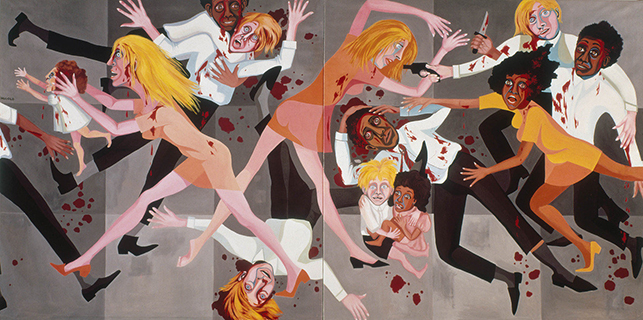
Faith Ringgold. American People Series #xx: Dice. 1967. Oil on canvas, two panels, 72 × 144″ (182.ix × 365.8 cm). The Museum of Modernistic Art, New York. Purchase, and souvenir of Sarah Peter. © 2016 Faith Ringgold/Artists Rights Lodge (ARS), New York
After seeing Faith Ringgold'southward monumental, harrowing painting, American People Series #20: Die (1967), currently installed in the Museum and reading Thomas J. Lax'due south incredibly thoughtful and moving postal service (as well as this recent find from ARTnews, I was inspired to reflect upon this new conquering. For while the painting has only recently arrived at the Museum, the artist was actively engaging with the institution on problems of race and exclusion during the aforementioned period of its making, the tardily 1960s. She painted the mural-size piece of work in summertime 1967 (known as the Long Hot Summer due to the more fifty pregnant riots that erupted in American cities), while her mother and daughters were traveling in Europe, using the vacant space of the cooperative Spectrum Gallery on 57th Street, non far from MoMA where only two years later she would protest.
In my function as Principal of Archives, I often find myself figuratively walking the halls of the Museum of years gone past. In a sort of modernistic archaeology, I turn to the letters, memoranda, and other ephemera institute in contemporary business records as the sediment and prove of past actions, much as ane does with the analysis of clay tablets and pot shards from ancient times. In the papers of senior leaders from that period, including founding managing director Alfred H. Barr, Jr. (retired 1967), and directors Bates Lowry (1968–69) [no relation to the Museum's current manager, Glenn D. Lowry] and John B. Hightower (1970–72), we find materials documenting this tumultuous moment, both at the Museum and in the rest of the world. It was a time when artists agitated for change, for more than command and inclusion in cultural institutions, as well equally addressing related social and political issues. [See this photograph of Ringgold (alongside daughter Michele Faith Wallace and Yvonne Rainer) protesting at MoMA in 1971.]
One such group was the Art Workers Coalition (AWC), in which Ringgold was active, and she, along with Tom Lloyd, co-led a black coalition within the grouping. The AWC was born out of an activity at MoMA on Jan 3, 1969, when the artist Takis removed his sculpture (which was endemic by the Museum) from an exhibition on the grounds that an creative person had the right to command the exhibition and handling of his work regardless of whether he had sold information technology. This provided the catalyst for a group of artists, architects, filmmakers, critics, and museum and gallery personnel to coalesce into the AWC. Throughout the course of the year, the AWC staged demonstrations, organized an open hearing, and attended meetings with MoMA staff to further their cause.
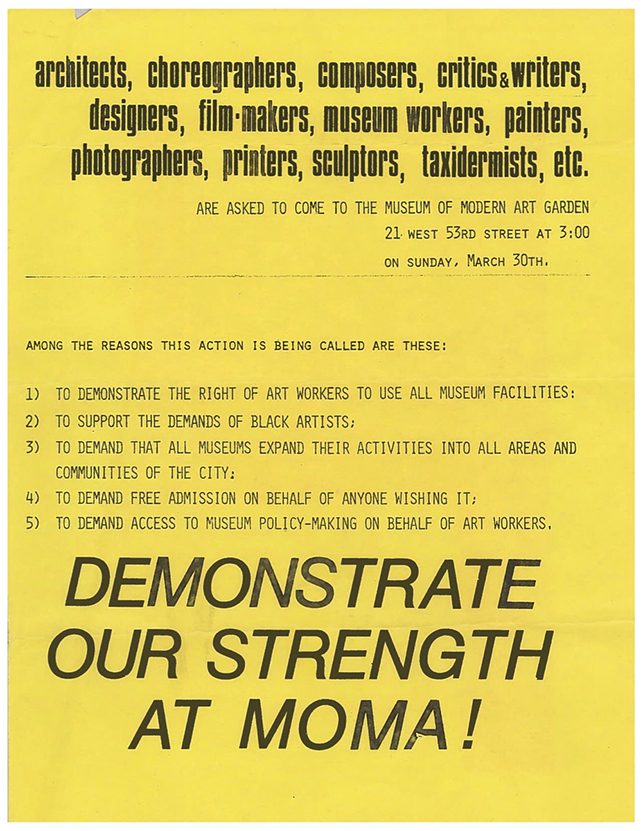
Flyer for demonstration on March thirty, 1969. Alfred H. Barr, Jr Papers, 1.489. The Museum of Modern Fine art Athenaeum, NY
The AWC's famous "13 Demands," submitted to Lowry on January 28, 1969, included point #two: "A section of the Museum, under the direction of blackness artists, should be devoted to showing the accomplishments of black artists." And item #3: "The Museum's activities should be extended into the Black, Spanish and other communities. Information technology should as well encourage exhibits with which these groups can place." Other AWC demands included free admission and the Museum's convening of a public hearing on the topic of "The Museum's Relationship to Artists and to Club." [Barr Papers, ane.489]
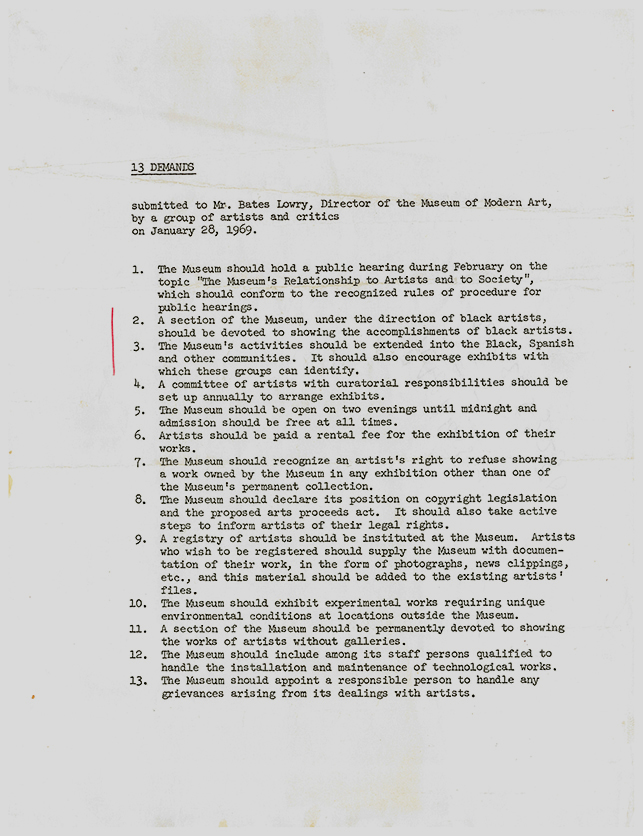
AWC "13 Demands." Barr Papers, one.489. MoMA Athenaeum, NY
On April three, 1969, Ringgold and Lloyd penned a letter to Lowry informing him of their intention to bring a group to visit the Museum on April sixteen, in lodge to evaluate its program in terms of meeting and serving the needs of minority populations. They wrote, "The glaring shortcomings of the Museum vis-à-vis the black and Puerto Rican communities clearly crave the setting up of a special Black Fly to enable the Museum to nowadays a harmonized portrayal of black culture in America." [reprinted in AWC "Open Hearing," John B. Hightower Papers, III.one.ten.]
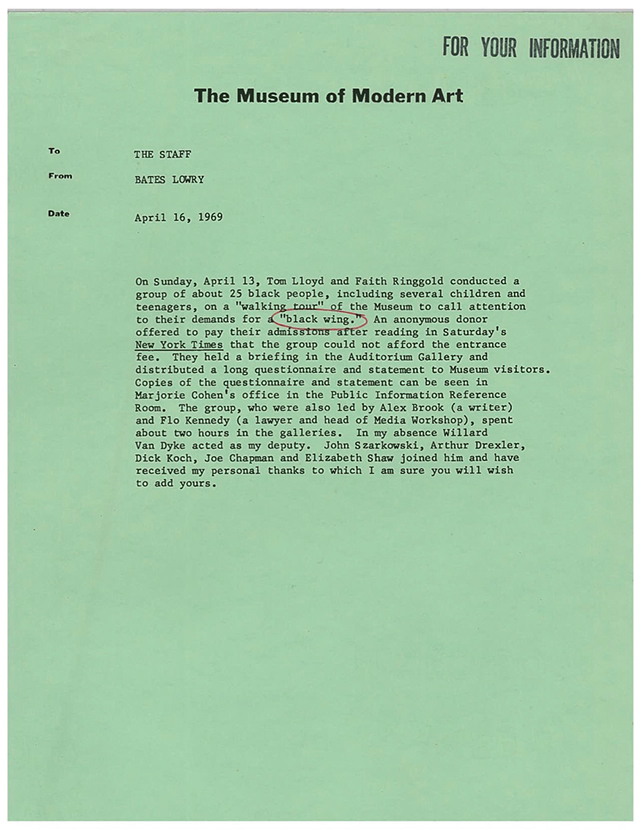
Memorandum Bates Lowry to Museum Staff, Apr 16, 1969. Barr Papers, 1.489. MoMA Archives, NY
They proposed naming the section the Martin Luther King, Jr., Wing for Black and Puerto Rican Fine art at The Museum of Modernistic Art. Not but a manner to laurels the slain ceremonious rights leader, the proposed championship was as well to be a rebuke to the institution. For on October 31–Nov 3 1968, the Museum hosted a tribute exhibition titled In Award of Dr. Martin Luther King, Jr. It consisted of of import and major works donated by approximately 80 leading American artists, all of which were to exist sold to do good the Southern Christian Leadership Conference, and concluded with a literary evening with readings by Ralph Ellison, James Baldwin, Robert Penn Warren, and Allen Ginsberg in the Museum auditorium.
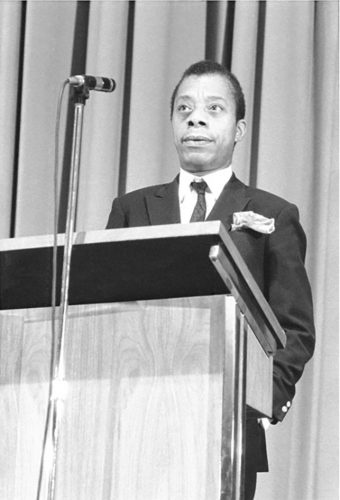
James Baldwin at "A Literary Evening in Honor of Dr. Martin Luther King, Jr." Photographic Archive. MoMA Archives, NY
The AWC alleged the exhibition included work by a nominal number of African American artists and information technology chastised the Museum for group them together in the final room of the show, leading to accusations of segregation. [The exhibition actually included work by over xx black artists installed in more than one gallery.]
Hightower assumed the directorship of the Museum in May 1970, and he proved sympathetic to the concerns previously foregrounded past the AWC and other artist protest groups, such as Guerilla Fine art Action Grouping (GAAG). At Hightower'south urging, the Museum'due south Board of Trustees convened a special subcommittee. A memo of June 29, 1970, with the discipline line "Blackness, Puerto Rican and Other Ethnic Studies Plan," indicated that the committee was charged "to study the role of the Museum of Modern Art with respect to the works of diverse indigenous groups and to recommend to the Board of Trustees any changes in the operations of the Museum which it may find advisable and desirable in order to increase its usefulness in this area." [Barr Papers, ane.489.] J. Frederick (Jeff) Byers III was appointed Chairman of the Committee, and Carroll Greene, Jr., who was then Curator of the Afro-American History Project at the Smithsonian Institution, was retained as a consultant.
Byers issued his report in June of 1971, recommending more accent on inclusion with acquisitions, exhibitions, and community programs. Two such outcomes of this initiative were the concurrent exhibitions: Romare Bearden: The Prevalence of Ritual and The Sculpture of Richard Hunt, both March 25–June 9, 1971.
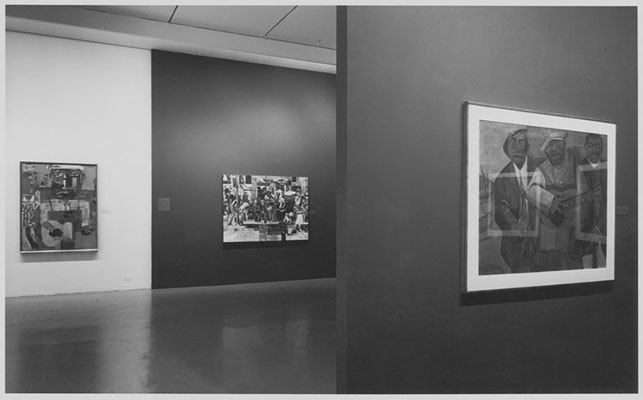
Installation view of the exhibition, Romare Bearden: The Prevalence of the Ritual. Photographic Annal. MoMA Archives, NY
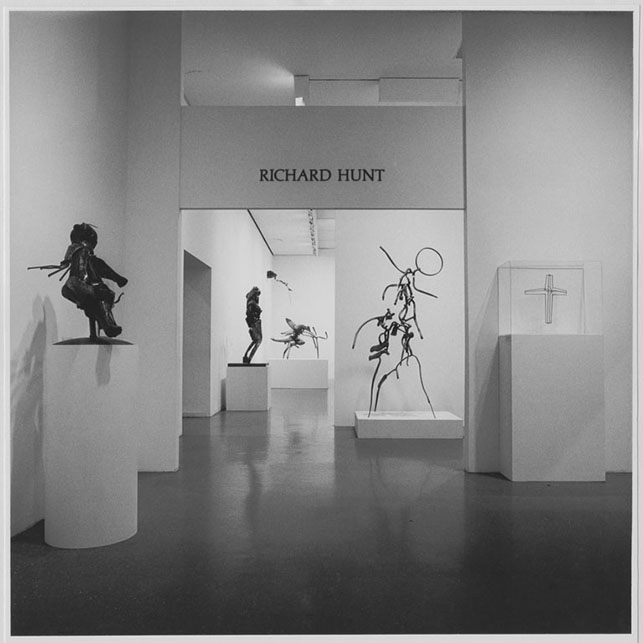
Installation view of the exhibition, The Sculpture of Richard Chase. Photographic Annal. MoMA Athenaeum, NY
But with the firing of Hightower just vi months afterward, the momentum from this moment was diminished.
As stated by Ringgold and Lloyd in the letter of Apr three, 1969, mentioned in a higher place, "All the same, there is little to be achieved by remonstrating over the sins of omission and commission in this area visited upon generations of the past. What is important is that the Museum has at present the opportunity to accomplish something in the way remedying those injustices in the present and the time to come." [reprinted in AWC "Open Hearing," John B. Hightower Papers, Three.one.ten.]

Creative person Faith Ringgold speaking in front end of her piece of work, U.s. of Attica (1972), for the Gallery Talks By Artists series which formed part of the week-long Contemporary Art in Context program, March 4, 1988. Museum-Related Photographs, 213. MoMA Archives, NY
The words of Ringgold and Lloyd still prevail upon us, and their actions and activism continue to band true, affect, and inform us today. Even if the shortcomings of our by do non exemplify our aspirations or expectations, information technology is of import to understand and narrate that by to help us shape a time to come of progress, inclusion, and promise.
You tin learn more about the stories of Faith Ringgold, the Art Workers Coalition, and other episodes in the Museum'southward long and diverse date with the art and artists of yesterday and today, from New York and from afar, in the some 6.5 1000000 documents that comprise the MoMA Archives.
Source: https://www.moma.org/explore/inside_out/2016/07/29/from-the-archives-faith-ringgold-the-art-workers-coalition-and-the-fight-for-inclusion-at-the-museum-of-modern-art/
0 Response to "The Art Workers Coalition Formed in 1968 Intially to Protest What"
Post a Comment